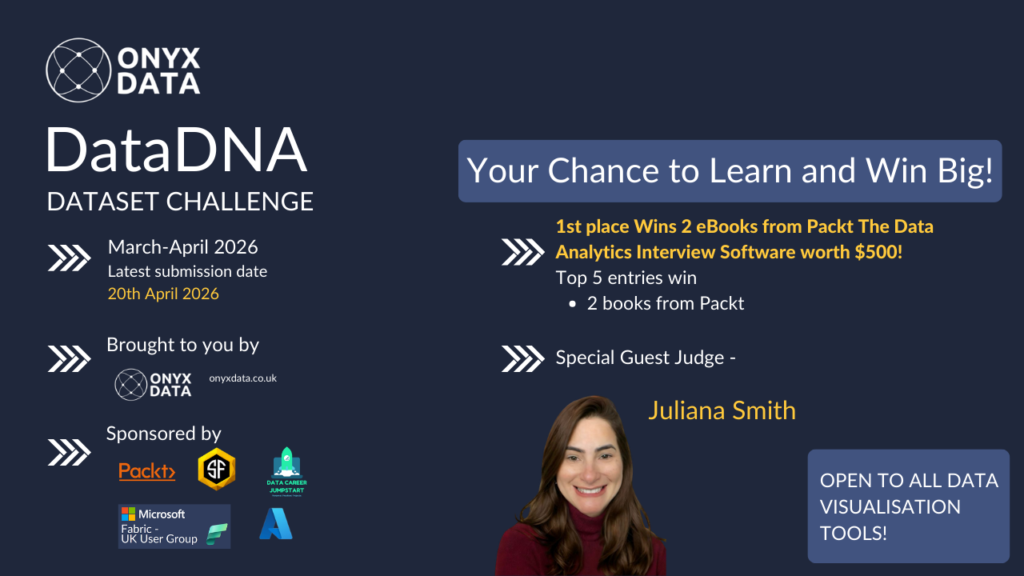


Welcome to the Data DNA - Dataset Challenge! This month we will be analysing the International Maritime Logistics & Terminal Efficiency Analytics Challenge dataset
By entering your full name and email address, you are agreeing to our privacy policy and consent to such details being shared with the named sponsor or other third-party affiliates who may use your details for marketing purposes.
You can unsubscribe at any time from such marketing as set out in our privacy policy.
Why Participate?
AI-Powered Feedback
Every submission receives detailed scores across four dimensions: Storytelling, Design, Technical, and Insights. Know exactly where you excel and where to improve.
Build Your Portfolio
Your best work becomes part of a verified portfolio that shows potential employers your actual skill levels, not just claims on a CV.
Earn Your Tier
Progress from Beginner to Intermediate to Advanced as you complete more challenges. Your tier reflects your demonstrated data visualisation skills.
How We Score Your Work
Our AI reviewer evaluates every submission across four dimensions:
1-5
Storytelling
Does your visualisation tell a clear, compelling story? We look for logical flow, context, and narrative progression that guides the viewer through your insights.
1-5
Design
Is your dashboard clean, readable, and visually appealing? We evaluate layout, typography, colour choices, and visual hierarchy.
1-5
Technical
Does your work demonstrate strong technical skills? We assess DAX usage, data modelling, chart type selection, and interactivity implementation.
1-5
Insights
Do you provide meaningful analysis? We look for non-obvious discoveries, actionable recommendations, and demonstrated business impact.
A score of 3 represents solid, competent work. Scores of 4-5 require exceptional evidence in that dimension.
What Happens After You Submit?
1
AI Review
Within 15-30 minutes, our AI reviewer analyses your submission and generates personalised feedback across all four scoring dimensions.
2
Email Feedback
If you opted into feedback emails, you'll receive your scores, strengths, areas for improvement, and a pro tip to help you level up.
3
Portfolio Draft
If you selected portfolio creation, a draft entry is added to your profile. Review it, refine your description, then publish when you're ready.
15Days Remaining
Prize Pool: 2 eBooks from Packt,The Data Analytics Interview Software worth $500!
Global maritime logistics operations across multiple international terminals face ongoing operational and strategic challenges, and this dataset highlights several critical areas:
Operational & Analytical Challenges
Fragmented visibility across regional hubs (EMEA, APAC, AMER) makes it difficult to understand true operational performance.
Variations in cargo movement times between terminals obscure which locations are efficient and which are driving delays.
The 2021 Suez disruption introduced volatility that complicates trend analysis and long-term capacity planning.
High container volumes at certain terminals may hide inefficiencies in move duration and resource allocation.
Limited visibility into terminal utilization versus terminal capacity makes expansion decisions difficult to justify.
Certain vessel categories may be creating congestion at specific terminals without clear identification.
Lack of clear drill-down from regional hub to terminal level limits accountability and local optimisation.
Operational differences across shifts (day vs night) are often not analysed, masking performance gaps.
Vessel characteristics such as age and category may influence movement duration without structured evaluation.
Difficulty linking terminal-level efficiency to overall movement time reduction weakens executive decision-making.
Step 2. Share a LinkedIn post on your profile with your visualisation image and tag directly using @ mention to: @OnyxData@SmartFramesUI@DataCareerJumpstart
and use the hashtag #dataDNA.
Step 3. In your post, share an image of your visualisation or dashboard (remember, it must be a single image).You can directly click on below button directly to share !
Business users use reports to make data-driven decisions. That’s why reports are called effective if they enable users to drill down and filter data quickly and intuitively to find answers to any question they might have and analyze data in all possible directions and dimensions.
We will evaluate:
1) How easy is it to understand the data? (Max 10 points)
Is too much text used for explanation?
Are the indicative colors in charts instinctually understandable?
Does it tell a story?
2) How easy-to-use is the report? (Max 14 points)
Cross-chart filtering implementation across the report. Can other visuals provide relevant data as the user explores the report?
Response time
Drill Down: Multi-layer data exploration. Can the user drill down and gain additional insights within the report?
Use of tutorial overlays and other elements to assist new users. Can a new user start using this report straight away with just the guidance provided within the report itself?
3) How good is the report design and is it suitable for its purpose? (Max 10 points)
Visual design: Is the overall look consistent, no empty spaces, no overcrowding?
Interface design: Are there unnecessary visualizations/buttons/complexity in use?
UX design: Is the produced report usable?
Report design: Is the main challenge answered?
Technical: Are all the fonts used the same, are the sizes readable?
You are encouraged to use various techniques at your disposal, such as tooltips, drill-throughs, drill-downs, cross-chart filtering, and page navigation features, to enhance your analysis.
Upcoming Webinar
No upcoming webinars available.
Past Webinar
Top 5 Pharmacy Sales & Profitability Reports: Power BI Best Practices Review
In this challenge, you will analyze a dataset representing a European pharmacy chain distributor operating across multiple European countries. The dataset includes daily sales transactions by pharmacy and product, with supporting dimensions for time, geography, and product hierarchy.
December 2025 DataDNA – Animal Shelter Operations Challenge
December 2025
In this challenge, you will analyze the Animal Shelter Intakes and Outcomes dataset from the City of Long Beach Animal Care Services. The dataset includes detailed information about each animal entering or leaving the shelter, such as species, intake type, condition, outcome type, and length of stay.
November 2025 DataDNA – E‑commerce Analytics Challenge
November 2025
E-commerce Analytics Challenge
Step into the role of a data analyst at a global software retailer that sells analytics, design, collaboration, and AI subscriptions. Your mission is to uncover what drives customer loyalty and identify which channels and campaigns lead to repeat purchases.
October 2025 DataDNA – Consumer Financial Complaints Analytics Challenge
October 2025
Consumer Financial Complaints Analytics Challenge
Step into the role of a data analyst at the Consumer Financial Protection Bureau (CFPB), a U.S. government agency ensuring fairness and accountability in the financial sector.
The CFPB collects complaints from consumers across the United States regarding financial products and services. Each complaint is tracked from submission through company response.
September 2025 DataDNA – Credit Risk Analytics Challenge
September 2025
In this challenge, you’ll act as a credit risk analyst at Nova Bank, a financial institution that provides personal, medical, education, and business loans across the USA, UK, and Canada. Nova Bank wants to make lending fair and accessible while also protecting itself from unnecessary risk.
August 2025 DataDNA – Fitness Membership Analytics Challenge
August 2025
Fitness Membership Analytics Challenge: Optimize Retention, Revenue, and Engagement
In this challenge, you'll take on the role of a data analyst at MyGym, a fast-growing fitness center chain with multiple locations across California. MyGym offers a wide range of membership tiers, subscription models, and amenities, including group classes, personal training, and multi-location access.
Gaining insights into how members engage with these services is crucial for optimizing operations and designing targeted, effective membership offers.
– Share a LinkedIn post with your visualization image and tag @OnyxData,@SmartFramesUI, @DataCareerJumpstart and @packt with #dataDNA.
– Share an image of your visualization or dashboard (single image only).
– Complete the entry form listed.
Only one entry is accepted for the challenge. After your first entry, no further entries will be accepted.
The challenge is open to all BI and data visualization tools.